Herwig Simons
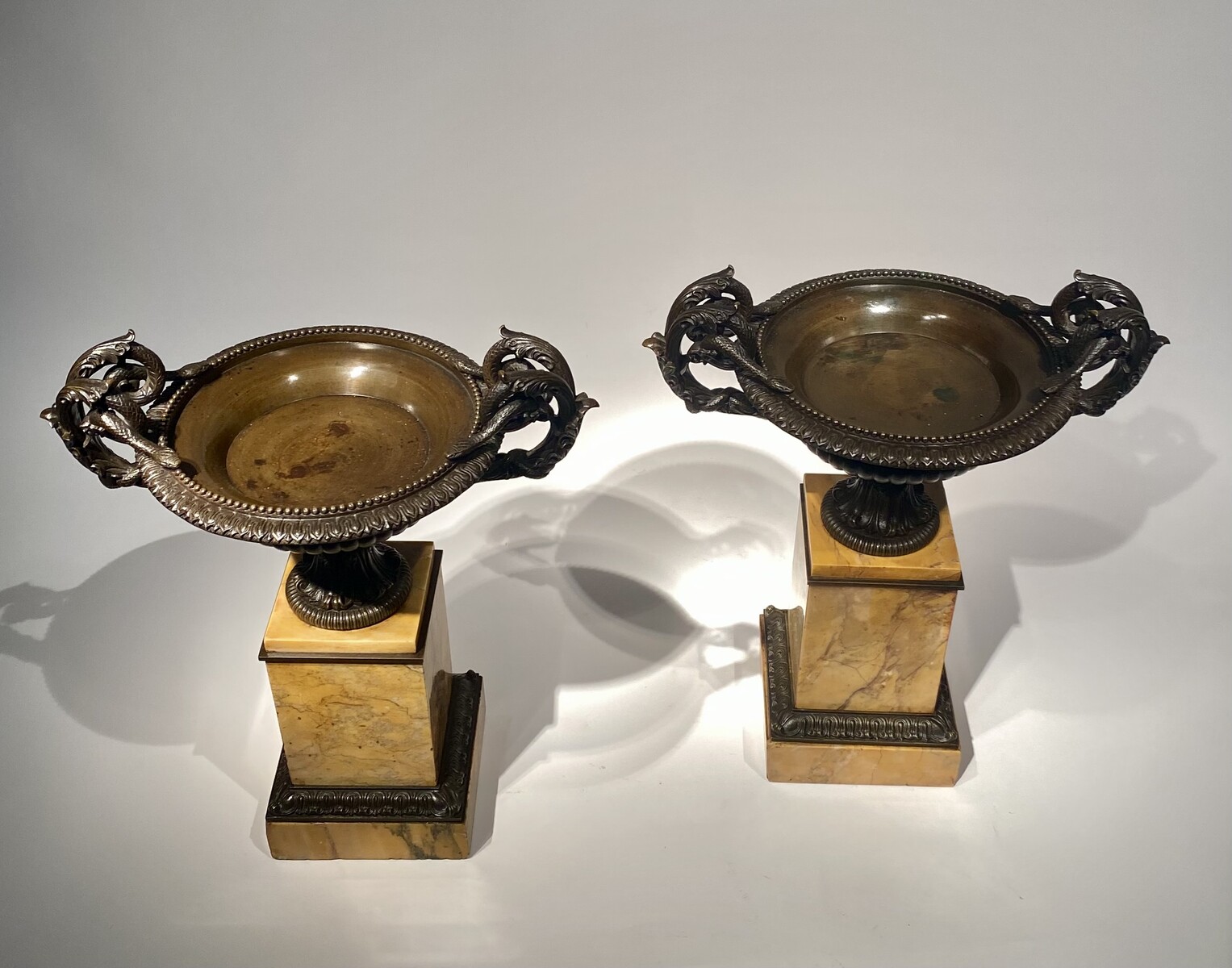
  • Large Pair of early 19th. century Grand Tour bronze Tazzas
  • Large Pair of early 19th. century Grand Tour bronze Tazzas
  • Large Pair of early 19th. century Grand Tour bronze Tazzas
  • Large Pair of early 19th. century Grand Tour bronze Tazzas
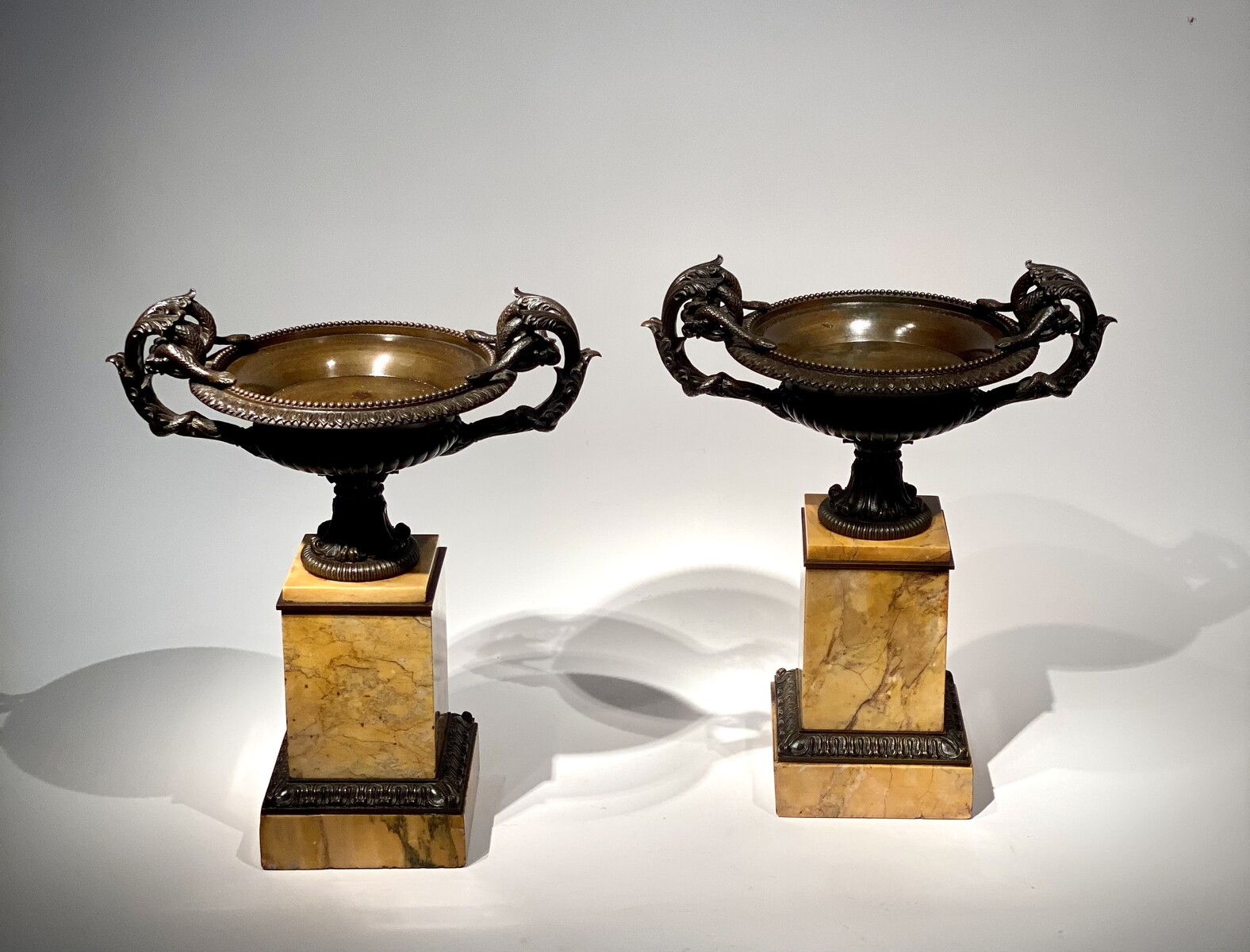
Large Pair of early 19th. century Grand Tour bronze Tazzas


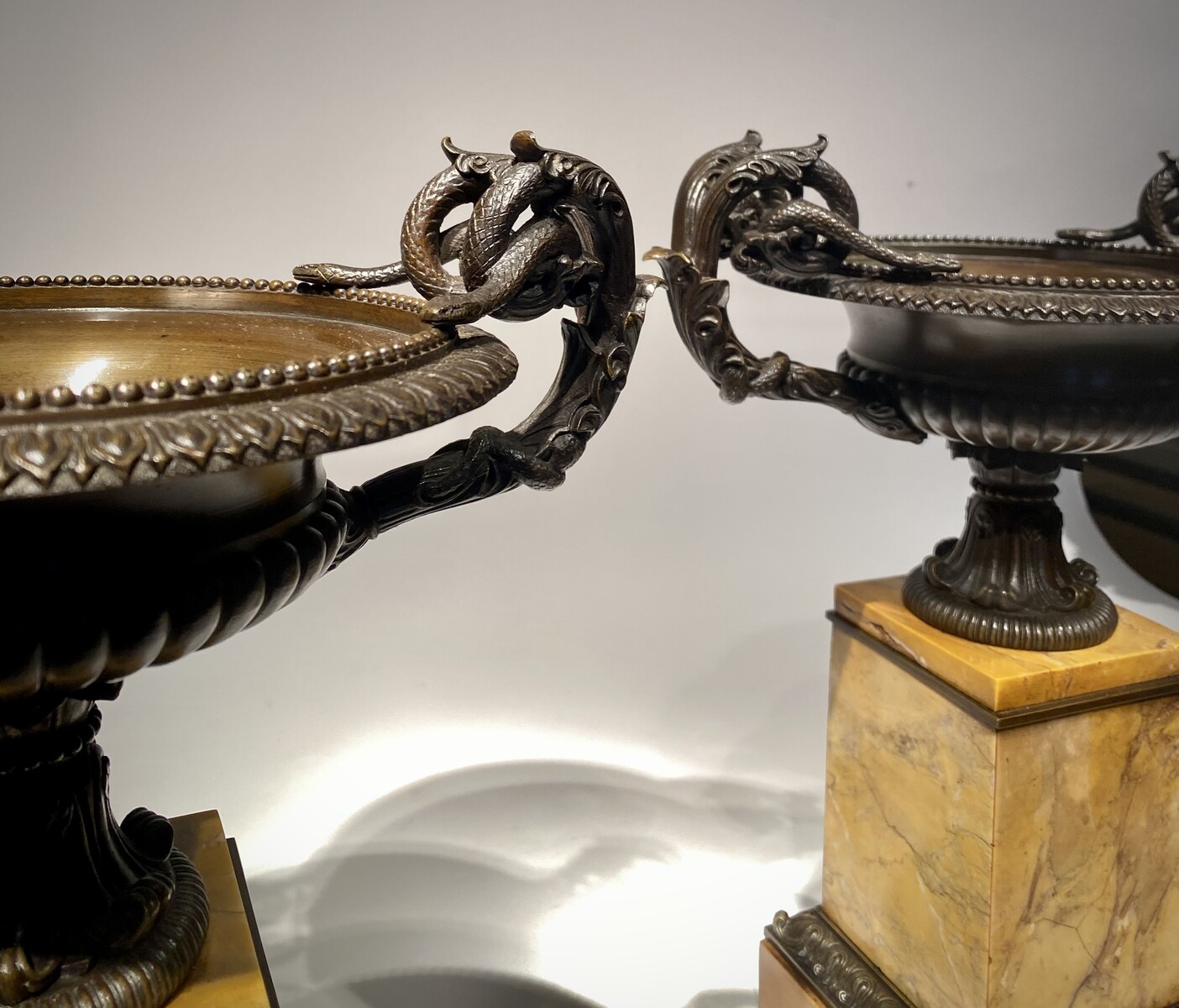
A fine and rare decorative pair of Grand Tour Bronze Tazzas of large scale on Sienna marble plints . The handles , which attach to the underside of the bowls are leaf-moulded and employ scroll work that finished in Serpent heads . The bases are in quality vivid yellow Sienna marble . Very nice smooth patina and good condition .H 34 cm.

Request for more information
See more items of this dealer
Print
Herwig Simons
Address:
Watteeustraat 27 ,
1000 Brussel
Region: Antwerpen
Country: Belgium
Tel.: +32 (0)475 467546
E-mail: Info@herwigsimons.be
Website: www.herwigsimons.be
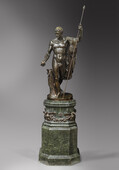
Napoleon in the guise of Mars the Peacemaker

Napoleon in the guise of Mars the Peacemaker

A 19th. century small version of the heroic 3M45 high bronze statue located in the courtyard of the Pinacoteca in Milan.
Bronze on a base in serpentine .
The bronze statue was made from a cast of the marble sculpture created between 1802 and 1806 by Antonio Canova, now on display in the stairwell at Apsley House, the Duke of Wellington's London residence.
Francesco (Italy1749-1819) and his son Luigi Righetti (Italy, 1780-1852)
Minor chips at the base.H 95 cm.


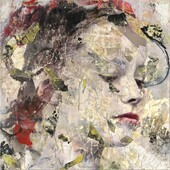
Lita Cabellut

Lita Cabellut

Mixed media on canvas ,White frame . 80 X 80 cm


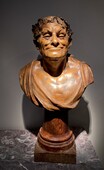
Terracotta sculpture of Bachus signed Goldscheider

Terracotta sculpture of Bachus signed Goldscheider

A rare terracotta sculpture of Bacchus, the Roman god of wine, shown here in a playful, slightly exaggerated caricature style.
Signed and numbered by Goldscheider ;
"Goldsheider , Reproduction Reservee 1075/54"
End of 19th. century.H 57 cm.


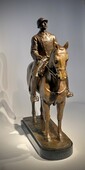
Bronze Sculpture representing Albert the first King of Belgium

Bronze Sculpture representing Albert the first King of Belgium

A fine reduced bronze equestrian sculpture depicts King Albert I of Belgium on his horse which was sculpted by Armand Martial in the 1930s. You can find the enormous statue close to the Place de la Concorde square, situated in a beautiful location near to the river Seine and the prestigious Avenue des Champs Elysees.
When France was on the verge of war with Germany, King Albert I of Belgium refused entry to the Germans within his country and therefor the monument was put in place dedicated the kings efforts during World War I .H 57 cm.


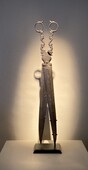
18th century Italian Padlock of large size

18th century Italian Padlock of large size

Very nice 18th century Italian iron padlock with his original key.
A shell-shaped cover lid covers the keyhole .
Big in size , 24 cm height by 17 cm width .
In good working order and comes on a new custom made black iron support.H 24 cm.


Question mark shaped Staircase Model

Question mark shaped Staircase Model

Fine question mark shaped staircase model in walnut.
Made by a Compagnonnage master end of the 19th century.H 33 cm.


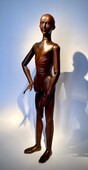
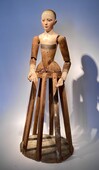
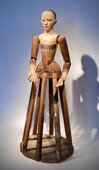
19th century Mannequin or Lay Figure

19th century Mannequin or Lay Figure

Very rare 19th century articulated artist model , mannequin or lay figure 
Made in the 17th century style .
He has a nice patina and comes on a custom made black metal support .H. 65 cm.

Comparanda , 
- Artempo Venice 2007 Palazzo Fortuny
- by Axel Vervoordt


Rooftop construction model of a Temple

Rooftop construction model of a Temple

Fine Compagnonnage model of a roof construction with a high central tower and symmetric two lower towers left and right, above a neo classical temple freeze. 
Marked with the letters U V G T what stands for Union, Vertu, Géométrie et Travail . The Eye stands for the eye of God , the architect of the Universe.H 58 cm. W 57 cm. D 30 cm.

Rooftop construction model of a Temple

Rooftop construction model of a Temple

Fine Compagnonnage model of a roof construction with a high central tower and symmetric two lower towers left and right, above a neo classical temple freeze. 
Marked with the letters U V G T what stands for Union, Vertu, Géométrie et Travail . The Eye stands for the eye of God , the architect of the Universe.H.57 cm W 58 cm D 30 cm


Gothic Tracery panel or Window

Gothic Tracery panel or Window

Superb Gothic stone carved tracery or window panel in white lime stone signed with a makers mark .
very good condition,
13th to 15th


l. 76 cm X H. 82 cm X P. 13 cm

Game box with chess and backgammon Eger, 17th century 48 x 48 x 11.5 cm

Game box with chess and backgammon Eger, 17th century 48 x 48 x 11.5 cm

Provenance: Lothar Schmid (1928-2013), German chess Grandmaster
Literature: publications World of Art: Art chamber games by the Kunsthistoriches Museum in Vienna 

Double-sided game box : one side shows a bas-relief depicting the meeting of Aeneas and Dido, accompanied by a Putto. The other side features a chessboard in finely executed marquetry. The interior reveals an elegant backgammon board decorated with double-tailed dolphins. Eger, a Bohemian Free City (now Cheb, Czech Republic), was well known in the 17th century for a specialised type of woodworking, particularly for intarsia panels. This set belonged to Lothar Schmid, the German chess Grandmaster and collector of chess books, boards and pieces. He is best known as the chief arbiter of the World Championship of chess in 1972 between Bobby Fisher and Boris Spassky in Reykjavik.

Wooden chef-d'oeuvre of the Compagnonnage France, 19th century Walnut, maple and mohogany wood H 185 cm Provenance: former private collection, France

Wooden chef-d'oeuvre of the Compagnonnage France, 19th century Walnut, maple and mohogany wood H 185 cm Provenance: former private collection, France

A fine, rare and large nineteenth-century wooden exhibition model, the chef d'oeuvre of a master carpenter of the Compagnonnage. These models were made to show the technical expertise and skill of the master carpenter. The Compagnonnage is an old French guild with roots in the 12th century. In the eighteenth century, they incorporated symbols and rituals, many of which were borrowed from Freemasonry to create an initiatory progression for its members.